
← All articles
April 13, 2026

While You Sleep, Your Spine Is Working: How Sleep Position Shapes Your Health

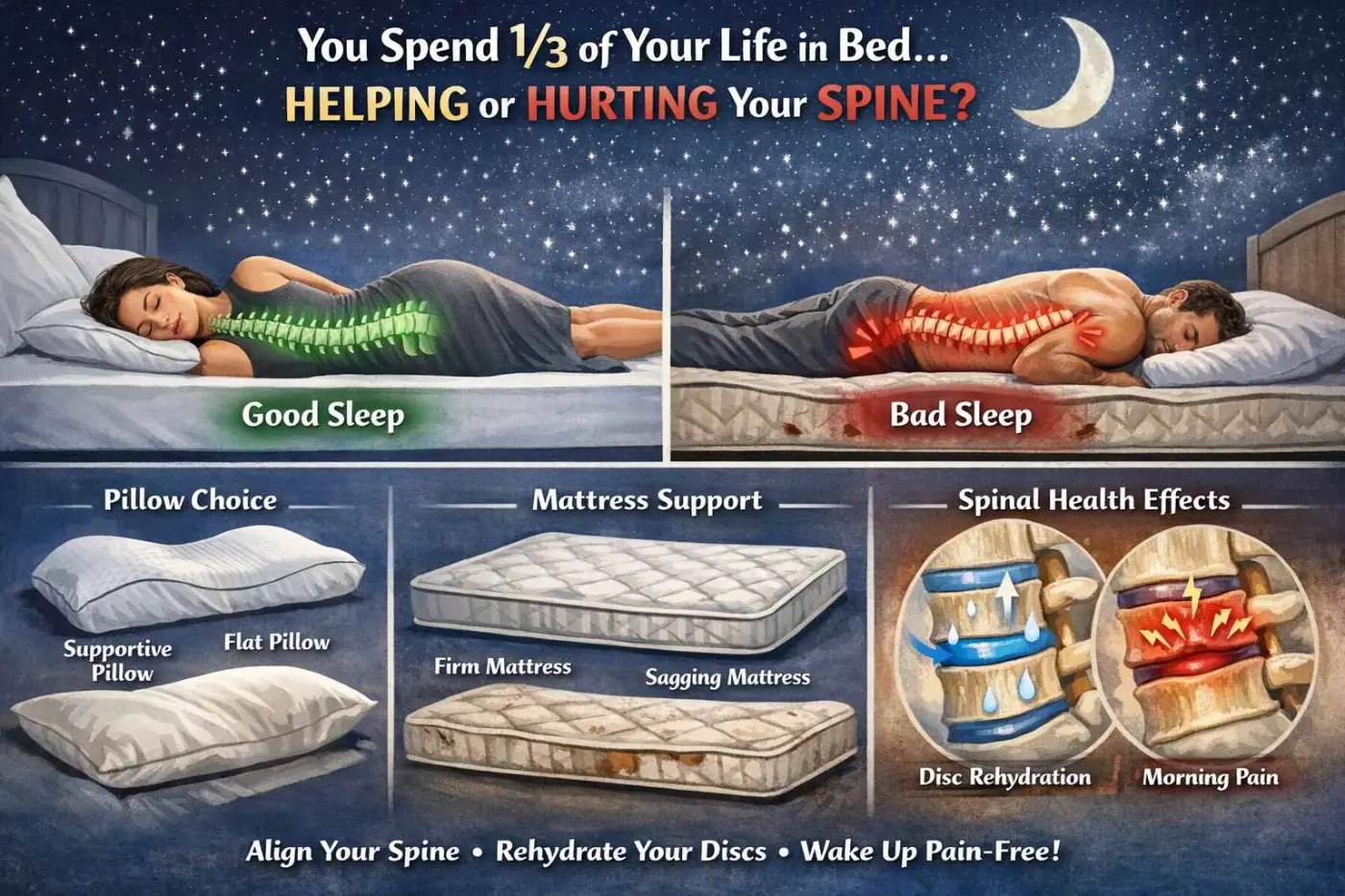
Every night you spend one-third of your life in bed — but are those hours helping or hurting your spine? Discover how sleep position, pillow choice, and mattress support directly impact spinal health, disc rehydration, and morning pain.

<p style="border-left:4px solid #d4a84b;padding-left:20px;font-size:18px;color:#2a4a2a;font-style:italic;margin-bottom:36px;line-height:1.7;">Every night you spend approximately one-third of your life in bed. During those hours, your spine is either recovering beautifully — or quietly accumulating stress that shows up as stiffness, pain, and dysfunction the next morning. The difference often comes down to something most people never think about: how they sleep.</p> <p style="margin-bottom:20px;font-size:16.5px;color:#333;">We spend enormous energy optimizing our waking hours — standing properly at our desks, stretching before a workout, wearing supportive shoes. Yet the seven to nine hours we spend unconscious each night, the time when our body is supposed to repair and restore itself, often goes completely unexamined. That's a missed opportunity for healing.</p> <p style="margin-bottom:20px;font-size:16.5px;color:#333;">As a chiropractor, some of the most common complaints I hear — morning low back stiffness, neck aches, shoulder tension, even headaches — trace back not to what patients did during the day, but to how they slept the night before. The good news: sleep posture is one of the most correctable health habits there is.</p><div style="display:grid;grid-template-columns:repeat(auto-fit,minmax(160px,1fr));gap:16px;margin:32px 0;"> <div style="background:#0d3d31;border-radius:14px;padding:24px 18px;text-align:center;border-top:3px solid #d4a84b;"><span style="font-family:Georgia,serif;font-size:36px;color:#d4a84b;font-weight:700;display:block;">1/3</span><div style="color:rgba(255,255,255,0.7);font-size:12px;margin-top:8px;">of your life spent sleeping — 26 years on average</div></div> <div style="background:#0d3d31;border-radius:14px;padding:24px 18px;text-align:center;border-top:3px solid #d4a84b;"><span style="font-family:Georgia,serif;font-size:38px;color:#d4a84b;font-weight:700;display:block;">90%</span><div style="color:rgba(255,255,255,0.7);font-size:12px;margin-top:8px;">of adults report back or neck pain that affects sleep</div></div> <div style="background:#0d3d31;border-radius:14px;padding:24px 18px;text-align:center;border-top:3px solid #d4a84b;"><span style="font-family:Georgia,serif;font-size:38px;color:#d4a84b;font-weight:700;display:block;">2x</span><div style="color:rgba(255,255,255,0.7);font-size:12px;margin-top:8px;">disc rehydration rate during sleep vs. waking hours</div></div> <div style="background:#0d3d31;border-radius:14px;padding:24px 18px;text-align:center;border-top:3px solid #d4a84b;"><span style="font-family:Georgia,serif;font-size:38px;color:#d4a84b;font-weight:700;display:block;">8hrs</span><div style="color:rgba(255,255,255,0.7);font-size:12px;margin-top:8px;">optimal window for spinal decompression and repair</div></div> </div><h2 style="font-family:Georgia,serif;font-size:26px;color:#0d3d31;margin:44px 0 16px;padding-bottom:10px;border-bottom:2px solid #e8f5ef;">What Happens to Your Spine While You Sleep</h2> <p style="margin-bottom:20px;font-size:16.5px;color:#333;"><strong style="color:#0d3d31;">Disc Rehydration.</strong> The intervertebral discs that cushion your vertebrae are largely avascular — they don't have their own blood supply. Instead, they absorb nutrients and water through a process called imbibition. During the day, compressive forces squeeze fluid out of the discs. At night, when you're lying down and removing that axial load, the discs can reabsorb water and nutrients. This rehydration is essential for disc height, shock absorption, and long-term disc health. If your sleeping position keeps compressive forces on certain disc segments, that repair cycle is disrupted.</p> <p style="margin-bottom:20px;font-size:16.5px;color:#333;"><strong style="color:#0d3d31;">Postural Muscle Recovery.</strong> The deep stabilizing muscles of your spine — the multifidus, the rotatores, the interspinales — work all day to hold you upright. Sleep is when they recover. If you're sleeping in a position that keeps these muscles isometrically contracted or stretched beyond their comfortable range, they don't fully recover. You wake up with that already-fatigued feeling before you've done anything.</p> <p style="margin-bottom:20px;font-size:16.5px;color:#333;"><strong style="color:#0d3d31;">Nervous System Restoration.</strong> The nervous system, particularly the parasympathetic branch, is most active during deep sleep. For those dealing with chronic pain, nerve irritation, or radiculopathy, quality sleep in a spine-supporting position is essential.</p> <div style="border-left:4px solid #d4a84b;background:#fffdf0;border-radius:0 12px 12px 0;padding:20px 24px;margin:28px 0;"> <div style="font-size:10px;font-weight:700;letter-spacing:2px;text-transform:uppercase;color:#d4a84b;margin-bottom:6px;">Clinical Insight</div> <p style="font-size:15px;color:#444;margin:0;">Research published in the <em>Journal of Pain Research</em> found that sleep disturbance and musculoskeletal pain have a bidirectional relationship — poor sleep worsens pain, and pain worsens sleep. Addressing sleep posture can break this cycle from both ends simultaneously.</p> </div><h2 style="font-family:Georgia,serif;font-size:26px;color:#0d3d31;margin:44px 0 16px;padding-bottom:10px;border-bottom:2px solid #e8f5ef;">The Three Sleep Positions — Ranked for Spinal Health</h2> <div style="display:grid;grid-template-columns:repeat(auto-fit,minmax(220px,1fr));gap:18px;margin:28px 0;"> <div style="background:linear-gradient(135deg,#f0faf6,#e8f5ef);border-radius:14px;padding:24px;border:1px solid #d0e8d8;"> <span style="font-size:36px;margin-bottom:10px;display:block;">&#128716;</span> <span style="display:inline-block;font-size:10px;font-weight:700;text-transform:uppercase;padding:3px 10px;border-radius:12px;background:#c5f0d8;color:#1a6b5a;margin-bottom:10px;">Best</span> <div style="font-family:Georgia,serif;font-size:17px;color:#0d3d31;margin-bottom:8px;">Side Sleeping (with support)</div> <p style="font-size:13.5px;color:#555;line-height:1.55;margin:0;">Maintains natural spinal curves when a pillow between the knees is used. Reduces snoring and acid reflux. Best position for most people with low back and hip issues.</p> </div> <div style="background:linear-gradient(135deg,#f0faf6,#e8f5ef);border-radius:14px;padding:24px;border:1px solid #d0e8d8;"> <span style="font-size:36px;margin-bottom:10px;display:block;">&#129496;</span> <span style="display:inline-block;font-size:10px;font-weight:700;text-transform:uppercase;padding:3px 10px;border-radius:12px;background:#c5f0d8;color:#1a6b5a;margin-bottom:10px;">Excellent</span> <div style="font-family:Georgia,serif;font-size:17px;color:#0d3d31;margin-bottom:8px;">Back Sleeping (supported)</div> <p style="font-size:13.5px;color:#555;line-height:1.55;margin:0;">Distributes weight evenly across the spine. A pillow under the knees maintains lumbar lordosis. Ideal for neck and back health — but can worsen snoring.</p> </div> <div style="background:linear-gradient(135deg,#fff5f5,#ffe8e8);border-radius:14px;padding:24px;border:1px solid #e8d0d0;"> <span style="font-size:36px;margin-bottom:10px;display:block;">&#128564;</span> <span style="display:inline-block;font-size:10px;font-weight:700;text-transform:uppercase;padding:3px 10px;border-radius:12px;background:#ffd0d0;color:#a03030;margin-bottom:10px;">Avoid</span> <div style="font-family:Georgia,serif;font-size:17px;color:#0d3d31;margin-bottom:8px;">Stomach Sleeping</div> <p style="font-size:13.5px;color:#555;line-height:1.55;margin:0;">Forces the neck to rotate 90°, straining cervical joints and muscles. Flattens lumbar curve, compressing lumbar discs and joints. Hardest position to support with pillows.</p> </div> </div><h2 style="font-family:Georgia,serif;font-size:26px;color:#0d3d31;margin:44px 0 16px;padding-bottom:10px;border-bottom:2px solid #e8f5ef;">Side Sleeping: Getting It Right</h2> <p style="margin-bottom:20px;font-size:16.5px;color:#333;">Side sleeping is the most common position — about 60% of adults prefer it. And for good reason: it's generally gentle on the lumbar spine, good for digestion, and easy on the airways. But the details matter enormously.</p> <p style="margin-bottom:20px;font-size:16.5px;color:#333;"><strong style="color:#0d3d31;">The pillow between the knees is non-negotiable.</strong> When you lie on your side without a pillow between your knees, your top leg naturally drops forward and downward. This pulls the pelvis into a rotated position, which creates a torque force on the lumbar spine and sacroiliac joints. Over eight hours, this torquing accumulates. A firm pillow placed between the knees keeps the hips stacked, pelvis neutral, and lumbar spine in alignment.</p> <p style="margin-bottom:20px;font-size:16.5px;color:#333;"><strong style="color:#0d3d31;">Your head pillow height matters.</strong> In side-lying, your head needs to be elevated enough to keep your cervical spine in a neutral position — meaning the ear is stacked directly over the shoulder. Most people need a medium-to-firm pillow, about 4–6 inches high depending on shoulder width.</p> <ul style="list-style:none;padding:0;margin:16px 0;"> <li style="display:flex;align-items:flex-start;gap:10px;margin-bottom:12px;font-size:15px;color:#444;"><span style="min-width:12px;height:12px;border-radius:50%;background:#2a8a5a;margin-top:4px;display:inline-block;"></span>Pillow between knees prevents hip drop and lumbar torsion</li> <li style="display:flex;align-items:flex-start;gap:10px;margin-bottom:12px;font-size:15px;color:#444;"><span style="min-width:12px;height:12px;border-radius:50%;background:#2a8a5a;margin-top:4px;display:inline-block;"></span>Cervical pillow height keeps ear directly above shoulder</li> <li style="display:flex;align-items:flex-start;gap:10px;margin-bottom:12px;font-size:15px;color:#444;"><span style="min-width:12px;height:12px;border-radius:50%;background:#e0a830;margin-top:4px;display:inline-block;"></span>Avoid tucking the chin to chest — keep airway open and cervical curve neutral</li> <li style="display:flex;align-items:flex-start;gap:10px;margin-bottom:12px;font-size:15px;color:#444;"><span style="min-width:12px;height:12px;border-radius:50%;background:#e05050;margin-top:4px;display:inline-block;"></span>Sleeping with arm under head puts prolonged pressure on brachial plexus — a common cause of morning hand numbness</li> </ul><h2 style="font-family:Georgia,serif;font-size:26px;color:#0d3d31;margin:44px 0 16px;padding-bottom:10px;border-bottom:2px solid #e8f5ef;">Back Sleeping: The Gold Standard (With Caveats)</h2> <p style="margin-bottom:20px;font-size:16.5px;color:#333;">From a pure spinal mechanics standpoint, back sleeping with proper support is ideal. Weight is distributed across the full surface area of your back, there's no rotational stress on the lumbar spine, and the cervical spine can be properly supported in its natural lordotic curve.</p> <p style="margin-bottom:20px;font-size:16.5px;color:#333;">The key modification: <strong style="color:#0d3d31;">place a firm pillow or rolled towel under your knees.</strong> This reduces tension on the hip flexors (particularly the iliopsoas) and allows the lumbar spine to relax into a gentle lordotic curve rather than pressing flat against the mattress. Without this support, the natural pull of the hip flexors can increase lumbar compression even in the supine position. The caveat: back sleeping exacerbates snoring and can worsen sleep apnea.</p> <h2 style="font-family:Georgia,serif;font-size:26px;color:#0d3d31;margin:44px 0 16px;padding-bottom:10px;border-bottom:2px solid #e8f5ef;">Stomach Sleeping: Why It's Causing You Problems</h2> <p style="margin-bottom:20px;font-size:16.5px;color:#333;"><strong style="color:#0d3d31;">Sustained cervical rotation.</strong> The neck can only rotate to one side or the other when you're face-down — there's no neutral position. This sustained 70–90° rotation puts significant compressive and shear forces on the cervical facet joints and keeps neck muscles in a shortened or lengthened position for hours. Morning neck stiffness and occipital headaches are common results.</p> <p style="margin-bottom:20px;font-size:16.5px;color:#333;"><strong style="color:#0d3d31;">Lumbar hyperextension.</strong> Lying face-down places the lumbar spine into hyperextension, compressing the posterior elements — facet joints, spinous processes — while stretching the anterior ligaments. For anyone with lumbar stenosis, facet syndrome, or spondylolisthesis, this can be genuinely aggravating.</p> <div style="border-left:4px solid #d4a84b;background:#fffdf0;border-radius:0 12px 12px 0;padding:20px 24px;margin:28px 0;"> <div style="font-size:10px;font-weight:700;letter-spacing:2px;text-transform:uppercase;color:#d4a84b;margin-bottom:6px;">For Stomach Sleepers</div> <p style="font-size:15px;color:#444;margin:0;">Transitioning away from stomach sleeping takes 4–6 weeks. Placing a body pillow alongside you can help prevent rolling onto your stomach. If you must sleep face-down, a very thin pillow (or no pillow) under your head reduces cervical rotation strain, and a pillow under the pelvis can reduce lumbar hyperextension.</p> </div><h2 style="font-family:Georgia,serif;font-size:26px;color:#0d3d31;margin:44px 0 16px;padding-bottom:10px;border-bottom:2px solid #e8f5ef;">Your Sleep Recovery Timeline</h2> <div style="border-left:3px solid #1a6b5a;padding-left:28px;margin:28px 0;"> <div style="margin-bottom:24px;"><div style="font-size:11px;font-weight:700;letter-spacing:1.5px;text-transform:uppercase;color:#d4a84b;margin-bottom:4px;">Minutes 0–20</div><div style="font-family:Georgia,serif;font-size:16px;color:#0d3d31;margin-bottom:4px;">Transition to Sleep</div><p style="font-size:14px;color:#555;margin:0;">As you fall asleep, muscle tone decreases and the spine begins to decompress. The position you settle into in this window sets the tone for the night.</p></div> <div style="margin-bottom:24px;"><div style="font-size:11px;font-weight:700;letter-spacing:1.5px;text-transform:uppercase;color:#d4a84b;margin-bottom:4px;">Hours 1–3</div><div style="font-family:Georgia,serif;font-size:16px;color:#0d3d31;margin-bottom:4px;">Deep Sleep — Peak Restoration</div><p style="font-size:14px;color:#555;margin:0;">Slow-wave sleep triggers growth hormone release. Disc rehydration begins in earnest. Postural muscles release accumulated tension. This is your spine's most active repair window.</p></div> <div style="margin-bottom:24px;"><div style="font-size:11px;font-weight:700;letter-spacing:1.5px;text-transform:uppercase;color:#d4a84b;margin-bottom:4px;">Hours 3–5</div><div style="font-family:Georgia,serif;font-size:16px;color:#0d3d31;margin-bottom:4px;">REM Cycles — Neural Recovery</div><p style="font-size:14px;color:#555;margin:0;">Nervous system consolidation. Proprioceptive and pain-sensing pathways reset. Quality sleep in this phase can genuinely reduce perceived pain the next day.</p></div> <div style="margin-bottom:24px;"><div style="font-size:11px;font-weight:700;letter-spacing:1.5px;text-transform:uppercase;color:#d4a84b;margin-bottom:4px;">Final 2 Hours</div><div style="font-family:Georgia,serif;font-size:16px;color:#0d3d31;margin-bottom:4px;">Lighter Sleep — Postural Shifts</div><p style="font-size:14px;color:#555;margin:0;">Natural movement increases. Position changes are healthy and normal. The position you're in when you wake determines how you rise — avoid twisting out of bed abruptly.</p></div> </div><h2 style="font-family:Georgia,serif;font-size:26px;color:#0d3d31;margin:44px 0 16px;padding-bottom:10px;border-bottom:2px solid #e8f5ef;">Practical Sleep Setup Tips</h2> <div style="display:grid;grid-template-columns:repeat(auto-fit,minmax(200px,1fr));gap:14px;margin:28px 0;"> <div style="background:linear-gradient(135deg,#f0faf6,#e8f5ef);border-radius:12px;padding:20px;border:1px solid #c8e8d8;"><span style="font-size:28px;margin-bottom:8px;display:block;">&#128273;</span><div style="font-family:Georgia,serif;font-size:15px;color:#0d3d31;margin-bottom:6px;">Pillow Between Knees</div><p style="font-size:13px;color:#555;line-height:1.5;margin:0;">Side sleepers: use a firm pillow between knees every night. This one habit alone can eliminate morning SI joint and low back pain for many patients.</p></div> <div style="background:linear-gradient(135deg,#f0faf6,#e8f5ef);border-radius:12px;padding:20px;border:1px solid #c8e8d8;"><span style="font-size:28px;margin-bottom:8px;display:block;">&#128716;</span><div style="font-family:Georgia,serif;font-size:15px;color:#0d3d31;margin-bottom:6px;">Under-Knee Support</div><p style="font-size:13px;color:#555;line-height:1.5;margin:0;">Back sleepers: fold a firm pillow or use a rolled towel under your knees to release hip flexor tension and support lumbar lordosis naturally.</p></div> <div style="background:linear-gradient(135deg,#f0faf6,#e8f5ef);border-radius:12px;padding:20px;border:1px solid #c8e8d8;"><span style="font-size:28px;margin-bottom:8px;display:block;">&#128247;</span><div style="font-family:Georgia,serif;font-size:15px;color:#0d3d31;margin-bottom:6px;">Screen Cutoff</div><p style="font-size:13px;color:#555;line-height:1.5;margin:0;">Avoid phones 45–60 min before bed. Blue light disrupts melatonin, and forward neck posture sets neck muscles tense before sleep.</p></div> <div style="background:linear-gradient(135deg,#f0faf6,#e8f5ef);border-radius:12px;padding:20px;border:1px solid #c8e8d8;"><span style="font-size:28px;margin-bottom:8px;display:block;">&#127777;</span><div style="font-family:Georgia,serif;font-size:15px;color:#0d3d31;margin-bottom:6px;">Room Temperature</div><p style="font-size:13px;color:#555;line-height:1.5;margin:0;">68–70°F is the optimal range for deep sleep. A cooler room allows your core temperature to drop — the trigger for slow-wave, restorative sleep.</p></div> <div style="background:linear-gradient(135deg,#f0faf6,#e8f5ef);border-radius:12px;padding:20px;border:1px solid #c8e8d8;"><span style="font-size:28px;margin-bottom:8px;display:block;">&#129496;</span><div style="font-family:Georgia,serif;font-size:15px;color:#0d3d31;margin-bottom:6px;">Pre-Sleep Stretch</div><p style="font-size:13px;color:#555;line-height:1.5;margin:0;">A 5-minute gentle spinal stretch before bed — child's pose, supine knees-to-chest, gentle neck rolls — releases compression accumulated during the day.</p></div> <div style="background:linear-gradient(135deg,#f0faf6,#e8f5ef);border-radius:12px;padding:20px;border:1px solid #c8e8d8;"><span style="font-size:28px;margin-bottom:8px;display:block;">&#9200;</span><div style="font-family:Georgia,serif;font-size:15px;color:#0d3d31;margin-bottom:6px;">Rise Carefully</div><p style="font-size:13px;color:#555;line-height:1.5;margin:0;">Roll to your side first, lower legs over the edge, then press up with your arms. This protects discs that are maximally hydrated in the morning.</p></div> </div><h2 style="font-family:Georgia,serif;font-size:26px;color:#0d3d31;margin:44px 0 16px;padding-bottom:10px;border-bottom:2px solid #e8f5ef;">When to Seek Care</h2> <p style="margin-bottom:20px;font-size:16.5px;color:#333;">Optimizing your sleep position is a powerful self-care tool — but it's not a substitute for professional evaluation when symptoms are significant. Consider scheduling an assessment if you experience:</p> <ul style="list-style:none;padding:0;margin:16px 0;"> <li style="display:flex;align-items:flex-start;gap:10px;margin-bottom:12px;font-size:15px;color:#444;"><span style="min-width:12px;height:12px;border-radius:50%;background:#e05050;margin-top:4px;display:inline-block;"></span>Pain that radiates down your arm or leg from the neck or back, especially upon waking</li> <li style="display:flex;align-items:flex-start;gap:10px;margin-bottom:12px;font-size:15px;color:#444;"><span style="min-width:12px;height:12px;border-radius:50%;background:#e05050;margin-top:4px;display:inline-block;"></span>Numbness, tingling, or weakness in the extremities that doesn't resolve within 30 minutes of rising</li> <li style="display:flex;align-items:flex-start;gap:10px;margin-bottom:12px;font-size:15px;color:#444;"><span style="min-width:12px;height:12px;border-radius:50%;background:#e0a830;margin-top:4px;display:inline-block;"></span>Morning stiffness lasting more than 45–60 minutes that doesn't improve with movement</li> <li style="display:flex;align-items:flex-start;gap:10px;margin-bottom:12px;font-size:15px;color:#444;"><span style="min-width:12px;height:12px;border-radius:50%;background:#2a8a5a;margin-top:4px;display:inline-block;"></span>Mild morning stiffness that resolves with movement — likely postural; try the tips in this article first</li> </ul> <p style="margin-bottom:20px;font-size:16.5px;color:#333;">Chiropractic care works synergistically with improved sleep hygiene. Spinal adjustments restore proper joint mobility and reduce nerve irritation, which in turn allows for deeper, more restorative sleep — creating a positive feedback loop of healing. Many patients report that sleep quality improves noticeably within the first few weeks of chiropractic care.</p> <p style="margin-bottom:20px;font-size:16.5px;color:#333;">Your spine never gets a true day off — it supports you in everything you do. The least you can do is give it eight good hours every night. With the right position, the right support, and a little intentionality, those hours become your most powerful health investment.</p> <div style="background:linear-gradient(135deg,#0d3d31 0%,#1a6b5a 100%);border-radius:20px;padding:48px 36px;text-align:center;margin-top:56px;"> <h2 style="font-family:Georgia,serif;color:#fff;font-size:28px;border:none;margin:0 0 14px;padding:0;">Wake Up Feeling Better</h2> <p style="color:rgba(255,255,255,0.75);font-size:16px;max-width:480px;margin:0 auto 28px;">If morning pain, stiffness, or poor sleep is affecting your quality of life, a chiropractic evaluation can identify what's driving it — and what to do about it.</p> <a href="https://ahpts.com" style="display:inline-block;background:linear-gradient(135deg,#d4a84b,#f0c96e);color:#0d3d31;font-weight:700;font-size:15px;padding:14px 36px;border-radius:50px;text-decoration:none;">Schedule a Consultation at AHPTS</a> </div>